by Brian Berns
This content is for educational and informational purposes only and should not be construed as investment advice, a recommendation, or an offer to buy or sell any security. Any strategies discussed are illustrative only and may not be suitable for all investors. This article reflects the experience of an individual user, is not representative of all customers, and should not be considered an endorsement or guarantee of future performance. The views and opinions expressed are those of the author and do not reflect or represent the views and opinions of Alpaca. Alpaca does not recommend any specific securities or investment strategies. The author was not compensated for this content but did receive nominal promotional items from Alpaca.
Introduction
I retired from professional software development last year, but still enjoy programming as much as ever. Since I don’t have a salary coming in anymore, I recently started wondering if I could write some software to experiment with automated stock trading. This quickly led to the (not very original) idea of creating an AI agent that could analyze market information and test trading strategies in a simulated environment.
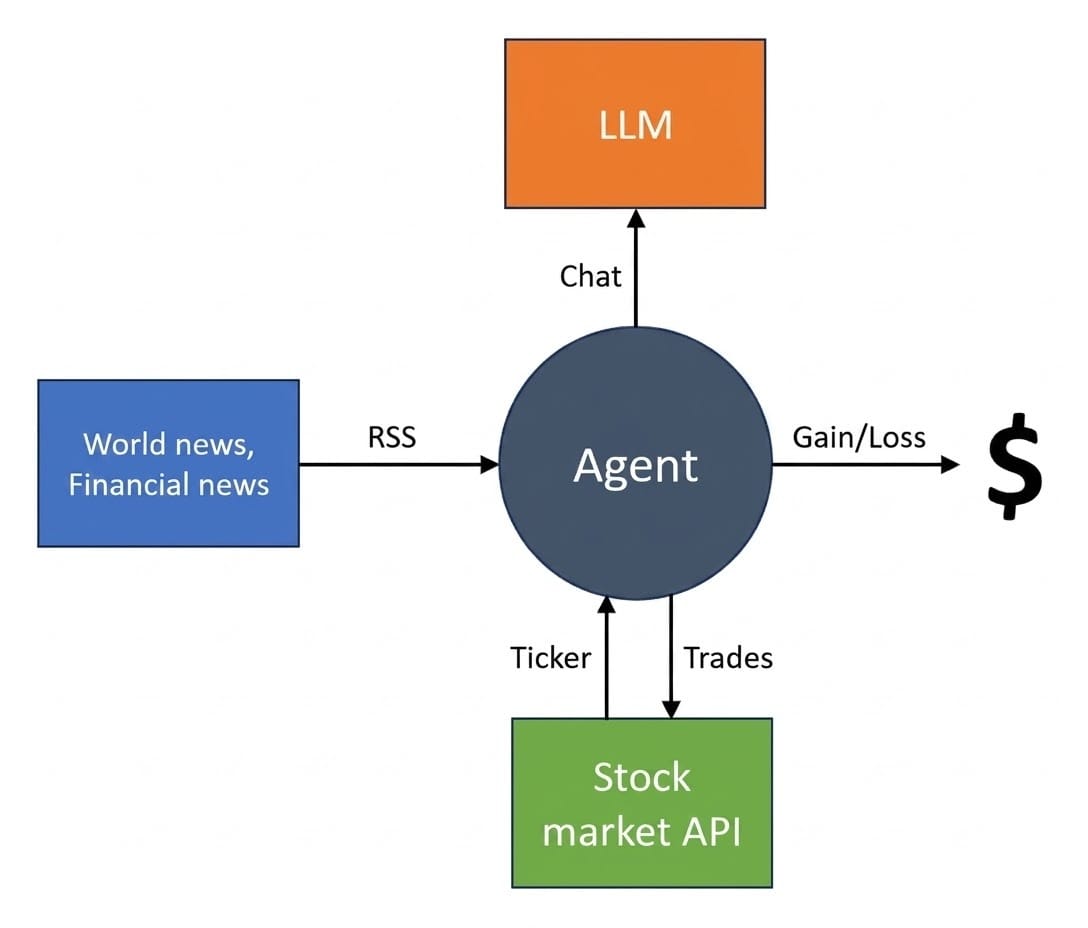
I don’t have much of a background in finance, but I thought that access to news about the world might give a stock-trading bot an advantage, similar to how it is used by human traders. My hope was that financial trends based on real-world news might persist for at least a few hours, long enough for a bot using consumer-grade AI to act on those trends. I knew this was a naive concept, but it seemed like a good starting point for a fun experiment. The design in my head looked like this:
Getting to work
I’m an F# developer, so I wanted to find .NET libraries that would provide access to the three boxes in the above diagram. I also wanted to keep subscription, transaction, and API costs low enough to run the experiment on paper.
A library that reads RSS feeds is available from Microsoft via System.ServiceModel.Syndication, so that part was easy. I was also familiar with LLM APIs from previous projects. But how could I get data about stocks (e.g. ticker prices) and make trades from a .NET application?
A few web searches led me directly to Alpaca’s C# SDK. It seemed perfect: My bot could easily get available market data, and then make simulated trades based on its conclusions, all on Alpaca’s paper account and the market-data tier I used for this project (with 15-minute delayed bars).
News feeds
Free RSS news feeds are easy to come by, although they are all delayed by at least 15 minutes. After some investigation, I settled on these:
I defined an F# news feed type like this:
/// RSS news feed.
type NewsFeed =
    {
        /// Feed name.
        Name : string

        /// Feed URL.
        Url : string

        /// Filters applicable to this feed.
        Filters : seq<NewsItemFilter>
    }

/// Filters items from a news feed.
and NewsItemFilter = SyndicationItem -> bool
Fetching items from a feed then looks like:
/// Gets the items currently in the given feed.
let getItemsAsync (httpClient : HttpClient) newsFeed =
    task {
        try
            let! rssXml = httpClient.GetStringAsync(newsFeed.Url)
            use stringReader = new StringReader(rssXml)
            use xmlReader = XmlReader.Create(stringReader)
            let feed = SyndicationFeed.Load(xmlReader)
            return Ok [|
                for item in feed.Items do
                    let keep =
                        Seq.forall (fun filter ->
                            filter item) newsFeed.Filters
                    if keep then
                        NewsItem.create
                            item.Id
                            item.PublishDate
                            item.Title.Text
                            item.Summary.Text
            |]
        with exn ->
            let error =
                NewsFeedError.create
                    newsFeed.Name exn.Message
            return Error error
    } |> Async.AwaitTask
This is an asynchronous function that returns an error value if something goes wrong, rather than throwing an exception. Representing failures like this forces the caller to handle the error explicitly, which can help reduce the risk of an unhandled exception interrupting the workflow.
A typical news item is:
{
  Id = "108353087"
  PublishDate = 8/24/2026 8:21:17 AM +00:00
  Title =
     "Alibaba plunges after announcing $10.2 billion share placement to
      fund AI push"
  Summary =
     "Alibaba shares plunged 10% after the tech giant priced a $10.2
      billion share placement to fund its growing AI investments."
}
Note that this contains only a summary of the actual news article, rather than its full content. I assumed optimistically that this is still rich enough to provide an initial input for further analysis
in many cases. However, news summaries may omit material context, and information generated from these summaries may be incomplete or inaccurate.
Market assessment
The next step was to feed these news items into an LLM and have it identify stocks of interest. For illustrative purposes, the prompt I settled on was:
"As a savvy stock trader, scan the news items below for robust trends that are likely to persist over a period of hours or days. Assess the overall state of the market and then identify the specific US companies that are likely to trend positive or negative in the market and explain why. Return ONLY ticker symbols (not company names) for liquid US equities"
The prompt above is provided solely to demonstrate how an LLM can be incorporated into a paper trading experiment. It should not be interpreted as a recommended trading strategy or as a reliable method for predicting future stock price movements.
I used a JSON schema to shape the response into a collection of assets that the LLM thinks are trending either positive or negative:
/// Assessment of the market.
type MarketAssessment =
    {
        /// Overall market state.
        State : string
        /// Asset assessments.
        AssetAssessments : AssetAssessment[]
    }
/// Asset assessment.
and AssetAssessment =
    {
        /// Asset in question.
        Asset : Asset
        /// Predicted asset trend.
        Trend : Trend
        /// Reason behind this assessment.
        Reason : string
    }
/// Asset symbol. E.g. Apple = "AAPL".
and Asset = string
/// Asset trend.
and Trend =
    | Positive = 0
    | Negative = 1
Note that this records the LLM’s prediction of each stock’s trend going forward, which may be very different from the stock’s actual trend up to this point.
A typical market assessment might look like this:
The following output is an illustrative example of an LLM-generated assessment and does not constitute investment advice or a recommendation to buy, sell, or hold any of the securities referenced. The statements and predictions have not been independently verified.
{
  State =
   "The US market is currently exhibiting a divergence where the Dow
    Jones is rising while the Nasdaq and S&P 500 are being dragged down
    by a significant correction in semiconductor and technology stocks."
  AssetAssessments = [|
    {
       Asset = STLD
       Trend = Positive
       Reason =
        "Benefiting from President Trump's threat of 50% tariffs on
         Canadian auto imports, which is expected to boost domestic
         steel demand."
    }
    {
       Asset = NUE
       Trend = Positive
       Reason =
        "Gaining momentum as trade tensions with Canada escalate,
         Positioning domestic steel producers as primary beneficiaries
         of new tariff policies."
    }
    {
       Asset = NVDA
       Trend = Negative
       Reason =
        "Currently trending negative as the stock dives alongside other
         tech giants ahead of its upcoming earnings release."
    }
  |]
}
Making trades
With a market assessment in hand, the agent could then use data from Alpaca to decide which stocks to buy and sell. I designed a simple algorithm:
- Group predicted positive-trending stocks together into a “might buy” group and predicted negative-trending stocks together into a “might sell” group.
- From the might-buy group, eliminate stocks that have not increased in price by at least 0.1% in the last hour. This provides an additional price-based check against the predicted trend, at least to some extent, before pulling the trigger on a purchase. (Note that ticker data is delayed by 15 minutes on Alpaca’s free tier.)
- For each asset in the bot’s current portfolio:
- If it is in the might-sell group, sell it
- Else if it is in the might-buy group, keep it
- Else if there are any stocks in the might-buy group, sell it to generate cash
- Use any cash now in the simulated portfolio to buy equal quantities of each stock in the might-buy group (if any).
This algorithm is implemented in a function that returns an array of sell order results and an array of buy order results:
/// Places orders based on the given assessment.
let placeOrders broker portfolio assessment =
    …   // implementation omitted for brevity
One entertaining, but possibly unwise, characteristic of this algorithm is that it churns assets frequently. It usually sells the bot’s entire portfolio any time it wants to buy anything. While this is certainly not a conventional strategy, it’s consistent with the idea of attempting to identify short-term trends that last only a few hours.
Frequent trading can increase transaction costs and expose investors to additional risks, including slippage, unfavorable execution prices, and losses resulting from rapid market movements. Automated trading strategies may also generate unintended transactions due to inaccurate data, programming errors, or system failures.
(This ran only on Alpaca paper; I am not presenting it as a strategy to replicate.)
Alpaca broker
In order to support this algorithm, I created an Alpaca API type:
open Alpaca.Markets

/// Alpaca API.
type Api =
    {
        /// Data client. (E.g. price history.)
        DataClient : IAlpacaDataClient

        /// Trading client. (E.g. buy/sell assets.)
        TradingClient : IAlpacaTradingClient
    }
I also defined five fundamental functions that use this API to act as a “broker” for buying and selling stocks:
- getPortfolio: Gets the current portfolio.
- isMarketOpen: Indicates whether the market is currently open.
- getPriceChange: Gets recent percentage change in a given asset’s price.
- sell: Sells a given quantity of a given asset.
- buy: Buys a given asset with the given money.
The functions share a common pattern of taking an Api instance as input and returning an F# Async<Result<’T, string>> type that contains either the desired data (of type ’T) or an error message if something went wrong. Again, this error handling pattern helps the application handle certain errors without an unhandled exception interrupting the program.
For example, here is the implementation of isMarketOpen:
/// Is the market currently open?
let isMarketOpen api =
    task {
        try
            let! clock = api.TradingClient.GetClockAsync()
            return Ok clock.IsOpen
        with exn ->
            return Error exn.Message
    } |> Async.AwaitTask
In order to buy and sell stocks, I created a helper function for placing a market order:
// Places the given order.
let placeOrder api (order : MarketOrder) =
    task {
        try
            let! posted =
                api.TradingClient.PostOrderAsync(order)
            match! awaitOrder api posted.OrderId with
                | Ok detail ->
                    return Ok detail
                | Error (Some status) ->
                    return Error $"Order status: {string status}"
                | Error None ->
                    return Error "Order still in progress"
        with exn ->
            return Error exn.Message
    } |> Async.AwaitTask
This uses another helper function (not shown) called awaitOrder that waits up to several seconds for a posted order to succeed or fail. Selling an asset is then simply a matter of creating and placing an Alpaca sell order:
/// Sells the given quantity of the given asset.
let sell api asset quantity =
    async {
        let order =
            MarketOrder.Sell(
                asset.Symbol,
                OrderQuantity.Fractional(quantity))
        return! placeOrder api order
    }
And buying an asset is similarly a matter of creating and placing a buy order:
type Money = Usd of decimal   // U.S. dollars ($)
/// Buys the given asset with the given money.
let buy api asset (Usd usd) =
    async {
        let usd = truncate (usd * 100m) / 100m   // limit to 2 places
        let order =
            MarketOrder.Buy(
                asset.Symbol,
                OrderQuantity.Notional(usd))
        return! placeOrder api order
    }
One interesting tidbit I learned while debugging this function is that Alpaca doesn’t let you spend fractions of a cent, so I had to truncate the money spent to two decimal places. These sorts of “business rules” are usually easy to bake into the broker implementation where needed.
Running the bot
With this machinery in place, we can now run one complete cycle of the bot, which follows a simple recipe (error handling omitted):
- Get the current portfolio
- If the market is open then
- Get a market assessment from the LLM by sending it the latest news items
- Buy and sell specific stocks based on the market assessment
The corresponding function has the following signature:
/// Result of a single run.
type RunResult =
    {
        /// Start of run.
        StartTime : DateTimeOffset
        /// Indicates whether the market is open.
        IsMarketOpen : bool
        /// Portfolio at start of run.
        PortfolioResult : Result<Portfolio, string (*message*)>
        /// Market assessment.
        MarketAssessmentResultOpt : Option<MarketAssessmentResult>
        /// Sell results.
        SellResults : OrderResult[]
        /// Buy results.
        BuyResults : OrderResult[]
        /// End of run.
        EndTime : DateTimeOffset
    }
/// Runs once using the given context.
let runOne context : Async<RunResult> =
    ...   // implementation omitted for brevity
We actually want the bot to run indefinitely every N minutes, which we can do with an F# asyncSeq:
/// Runs in an infinite loop using the given context.
let runLoop context delay : AsyncSeq<RunResult> =
    asyncSeq {
        while true do
            let! result = runOne context
            yield result
            do! Async.Sleep(delay : TimeSpan)
    }
Stock trading website
Sticking with the F# theme, I wanted to run the bot on a Suave web server using Fable remoting. The server component hosting the bot exposes a simple API that returns all the results accumulated so far:
type IStockTradingBotApi =
    {
        GetResults : unit -> Async<RunResult[]>
    }
This makes it easy to consume the stock trading API from an F# Fable client using a purely functional “Elmish” architecture. The client just has to render the run results in a readable way, but since I’m more of a back-end developer (and allergic to CSS in particular), I decided to let Claude Code write the front end for me. Feliz provides a React-based domain-specific language (DSL) to declare HTML elements needed at runtime. For example, rendering a RunResult is done as follows:
open Feliz
/// Renders a single run as a card.
let renderRun (runResult : RunResult) =
    Html.div [
        prop.className "run-card"
        prop.children [
            Html.div [
                prop.className "run-header"
                prop.children [
                    Html.span [
                        prop.className "run-time"
                        prop.text (formatTimestamp runResult.EndTime)
                    ]
                    Html.span [
                        prop.className "run-duration"
                        prop.text
                            (formatDuration
                                runResult.StartTime runResult.EndTime)
                    ]
                ]
            ]
                // portfolio is always fetched
            renderPortfolio runResult.PortfolioResult
                // is the market open?
            if runResult.IsMarketOpen then
                match runResult.MarketAssessmentResultOpt with
                    | Some assessmentResult ->
                        renderMarketAssessment assessmentResult
                    | None -> Html.none
                renderOrders runResult.SellResults runResult.BuyResults
            else
                Html.div [
                    prop.className "closed"
                    prop.text "Market is closed"
                ]
        ]
    ]
The resulting web page looks like this:
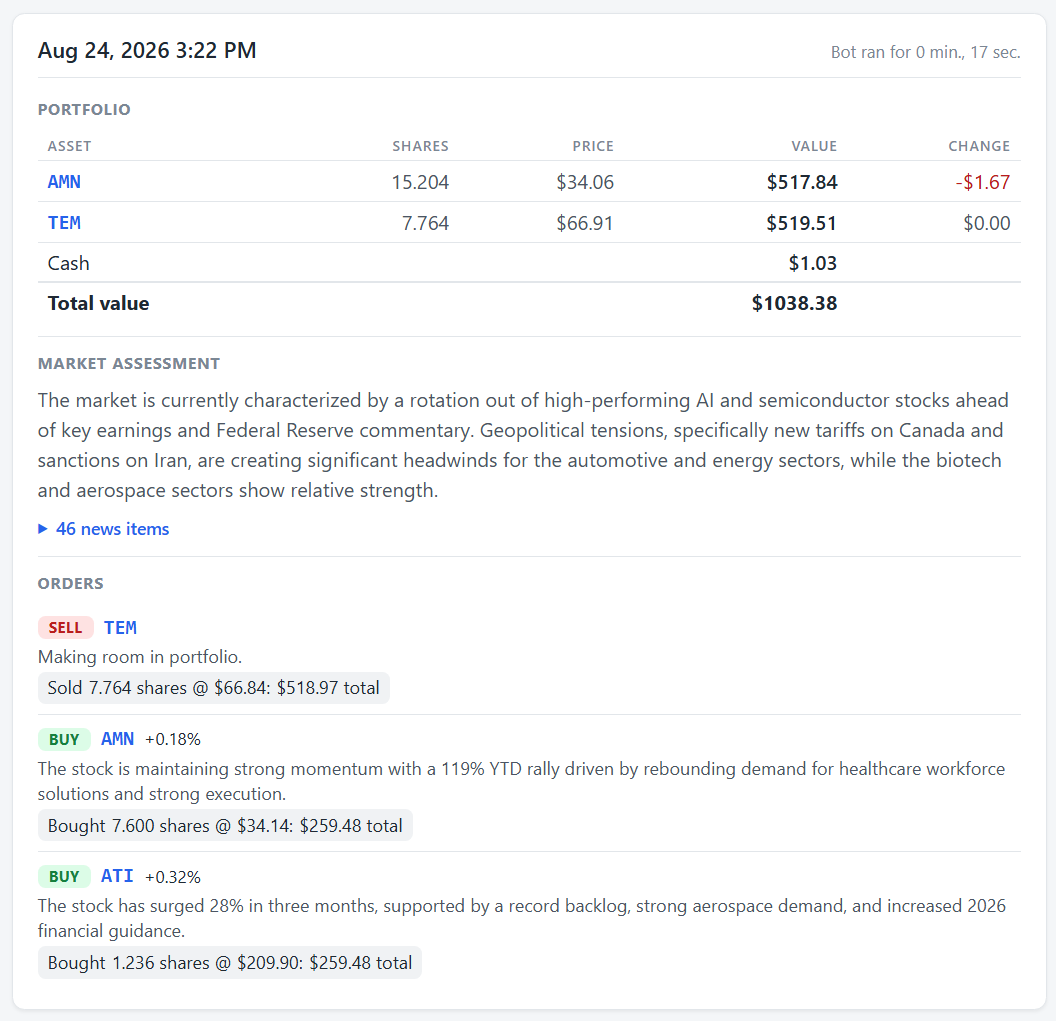
All the source code is available on GitHub and you can see how the bot is doing for yourself on my website here: https://www.bernsrite.com/StockTradingBot/
The website reflects an experimental paper trading project. Any performance or results displayed are simulated and may change over time. They should not be relied upon as an indication of actual or future trading performance.
Results so far
During the period from July 7 through August 27, 2026, the stock trading bot generated an approximately 10% simulated return on an initial paper trading balance of $1,000, compared with an approximately 1% increase in the Dow Jones Industrial Average over the same period.
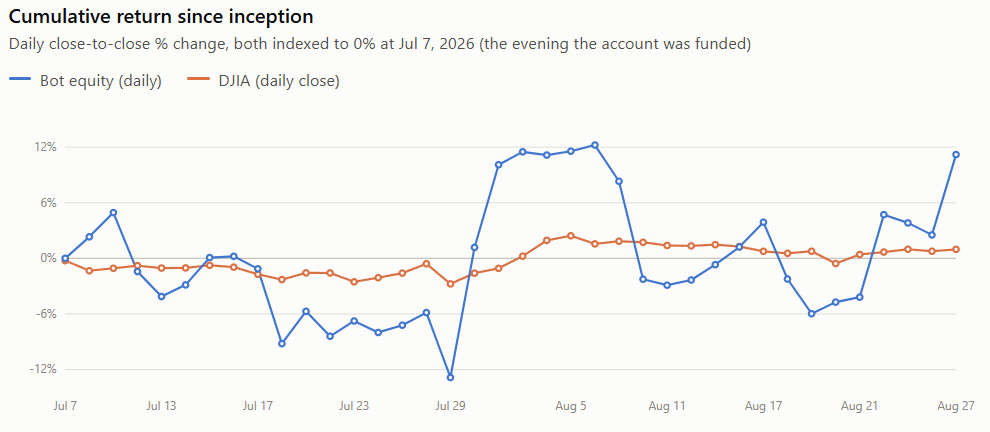
Paper trading results are hypothetical and simulated, do not represent actual investment performance or market executions, and may not account for real-world factors such as slippage, transaction costs, market impact, or liquidity constraints. The results reflect a limited testing period, and the benchmark comparison does not account for differences in portfolio composition, risk exposure, trading frequency, or execution conditions. Simulated results are not indicative of future performance or results that could be achieved in live trading.
However, the value of the simulated portfolio has see-sawed quite a bit over that time, rather than exhibiting a steady trend, which is probably to be expected given the agent’s tendency to churn. Since all of the transactions go through the Alpaca Trading API, I’m able to use my Alpaca dashboard to analyze every trade. However, the bot’s website is the only place where the reasoning behind those transactions is currently kept.
I consider the project a success so far, because it has demonstrated the viability of integrating news feeds with stock purchases via generative AI and shown occasional hints of competence. However, I probably wouldn’t trust it with any real money quite yet. Outperforming a benchmark over the long run is notoriously difficult, even for human experts with access to real-time data. If I were to push forward with the idea, here are the areas I would focus on improving next:
- Send the full content of news items to the LLM, rather than just the headlines and summaries.
- Send historical bars from Alpaca paper to the LLM for the stocks it identifies. Right now, the LLM has no insight into how the assets have performed over time, and is simply reacting to news feeds alone.
- Reduce churn by holding onto stocks that are performing well, even if they are no longer in the news.
Additional Resources
If you want to start building your own systematic trading system, here are the resources I found most useful:
- Alpaca's Trading API – the place to start
- Alpaca Paper Trading – set up a paper account, same API, same execution,
- Alpaca Market Data API – historical and real-time data
- alpaca-py on GitHub
- Alpaca’s MCP Server for Trading API
About the Author
Brian Berns is a software developer with more than 35 years of professional experience in all aspects of software development, including technical leadership and project management. From 2006 to 2025, he was focused on building software applications that improve human health using both clinical and genetic data. Now retired, he brings those same skills to writing open-source software.
The code examples above are provided for educational purposes and were used in a simulated paper trading environment. They should be independently tested and reviewed before being adapted for live trading.
The Paper Trading API is offered by AlpacaDB, Inc. and does not require real money or permit a user to transact in real securities in the market. Providing use of the Paper Trading API is not an offer or solicitation to buy or sell securities, securities derivative or futures products of any kind, or any type of trading or investment advice, recommendation or strategy, given or in any manner endorsed by AlpacaDB, Inc. or any AlpacaDB, Inc. affiliate and the information made available through the Paper Trading API is not an offer or solicitation of any kind in any jurisdiction where AlpacaDB, Inc. or any AlpacaDB, Inc. affiliate (collectively, “Alpaca”) is not authorized to do business.
The performance results presented are simulated and based on paper trading activity. Simulated results have inherent limitations and may not reflect actual trading conditions, including liquidity, slippage, market impact, execution prices, and transaction costs. These results reflect a limited testing period and should not be considered representative of future performance.
This article is provided for educational and informational purposes only and does not constitute investment advice or a recommendation to buy, sell, or hold any security. The securities, trading strategies, and examples discussed are illustrative only and may not be suitable for all investors. Alpaca does not recommend any specific security or investment strategy. The views expressed are those of the author and do not necessarily reflect those of Alpaca.
AI-generated outputs, including market assessments and trading signals, may contain errors, omissions, inaccuracies, or outdated information and should be independently reviewed and verified before use or reliance. Automated trading involves risks, including programming errors, API connectivity issues, system failures, unintended orders, and potential financial losses. Automated checks, testing, and risk controls cannot guarantee the prevention of errors or losses.
References to third-party products, news sources, or services are provided for informational purposes only and do not constitute an endorsement or recommendation by Alpaca. Alpaca does not guarantee the accuracy or completeness of information provided by independent third-party sources.
All investments involve risk, including the potential loss of principal. Past performance and simulated results are not indicative of future performance. Investors should consider their investment objectives and risk tolerance before investing.
Securities brokerage services are provided by Alpaca Securities LLC (dba "Alpaca Clearing"), member FINRA/SIPC, a wholly-owned subsidiary of AlpacaDB, Inc. Technology and services are offered by AlpacaDB, Inc.
This is not an offer, solicitation of an offer, or advice to buy or sell securities or open a brokerage account in any jurisdiction where Alpaca Securities is not registered or licensed, as applicable.